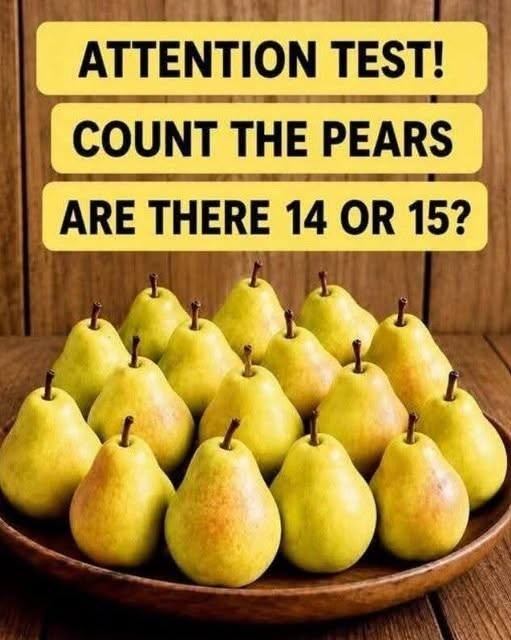
2. Divide the Image Into Sections
Break a crowded image into rows, columns, corners, or other sections.
3. Look for Distinguishing Features
When objects overlap, look for stems, edges, shadows, handles, or other details that can identify individual objects.
4. Count Slowly
Speed isn’t the goal. Accuracy is.
5. Count a Second Time
After reaching an answer, start again using a different method. If you get the same number twice, you’re much more likely to be correct.
Did You Fall for the Trick?
Now that you know the solution, think about your first answer.
Did you initially choose 14?
Maybe you counted carefully and decided there were 15.
Or perhaps you immediately suspected that the puzzle was trying to trick you and searched for an answer outside the two choices.
If you found 16, congratulations! You successfully ignored the misleading choices and paid attention to every layer of the picture.
If you didn’t, don’t worry. The puzzle was specifically designed to make the obvious choices seem convincing.
Challenge Your Friends
This is also a fun puzzle to share with friends and family.
Show them the picture without revealing the answer and ask:
“How many pears can you count?”
Don’t tell them that 14 and 15 are both wrong. Let them make their own decision.
You may be surprised by how many people immediately choose one of the numbers suggested by the puzzle.
After they give their answer, reveal the actual total of 16 and explain how the pears are arranged in four separate layers.
It makes for a simple but entertaining attention challenge.
Conclusion :
The “Attention Test! Count the Pears” puzzle proves that a seemingly easy counting task can become surprisingly challenging when visual information is arranged to distract you.
The image gives you two tempting choices—14 or 15—but neither is correct. By slowing down, examining the pears row by row, and using their stems as clues, you can uncover the complete arrangement.
There are 4 pears in the front, 5 in the second row, 4 in the third row, and 3 in the back, giving us a final total of 16 pears.
The biggest lesson isn’t simply the number 16. It’s the importance of questioning your first impression. When a puzzle gives you an apparently obvious choice, don’t assume the answer must be hiding among those options. Sometimes the real solution is the one you aren’t expecting.
So, how did you do?
Did you count all 16 pears, or did the 14-versus-15 trick fool you?
For Complete Cooking STEPS Please Head On Over To Next Page Or Open button (>)

Chef’s Clever Hack for Perfectly Peeled Hard-Boiled Eggs

Meat Is Not as Delicious as Cabbage

Creamy Mushroom Soup

Portuguese Linguiça and Cabbage Soup

Crunchy Chicken Taco Salad